Viburnum leaf
beetle home
Logo images by Kent Loeffler, Paul Weston & Craig Cramer
|
What do you mean by Citizen Science?
Quite simply, we mean involving knowledgeable and motivated citizens in meaningful scientific research. In this case, researchers need help learning more about the spread of viburnum leaf beetle to help minimize damage by this pest. They can't be everywhere. So we're calling on folks (like you) to help supply information so researchers can track its spread.
This website will help you learn more about viburnum leaf beetles so that you can gather data from plants in your area and submit the information via an online form. Researchers will analyze the data to better understand where the pest is and where it's heading, which viburnums are most resistant, how weather affects infestations, and other key concepts.
top
Why are scientists interested in the viburnum leaf beetle (VLB)?
Because this imported pest has already caused considerable damage to our landscape and has the potential to keep spreading and wreak even more havoc.
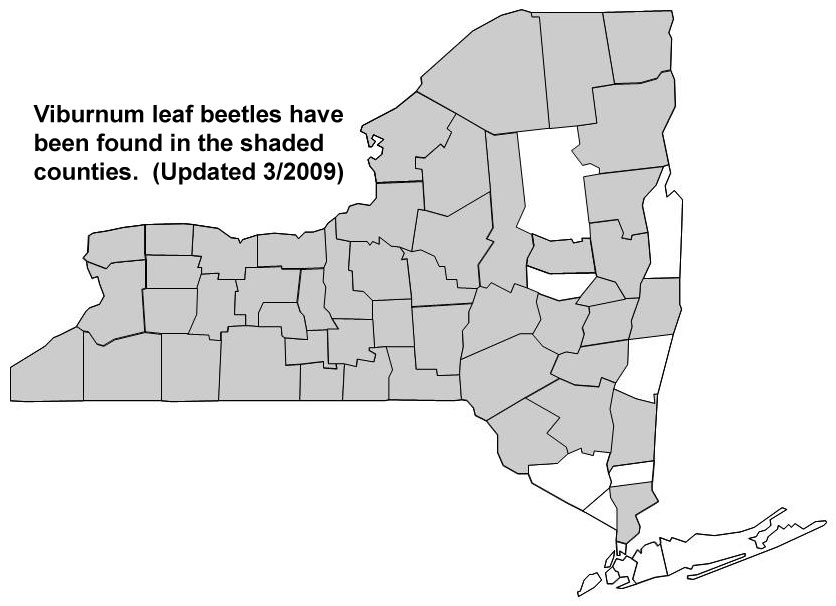
A native of Europe, the beetle was first sighted in North America in 1947 in Canada. The first sighting in New York was at Fair Haven Beach State Park on Lake Ontario in 1996, and it has spread rapidly since then.
As of 2007, it was found in nearly all counties in upstate New York (N.Y. map), as well as in parts of Maine, Pennsylvania, Vermont, New Hampshire and Ohio (national map).
Even though VLBs only harm viburnum shrubs, scientists are concerned that they will easily adapt to our climate because it is similar to Europe's. They may spread quickly here because they don't have the same natural enemies that they had to keep them in check in Europe.
As people and goods move more easily between countries, the chances of accidentally introducing other non-native pests increases. Scientists hope that what we learn from studying VLBs will help us cope with other pests that arrive on our shores, such as the Asian longhorned beetle.
top
Why should I be interested in the viburnum leaf beetle?
If you grow susceptible species of viburnum in your garden or landscape, they may die if they suffer from heavy and repeated infestations. Even if you don't grow them yourself, once you become aware of viburnums you'll recognize that they are common in public landscape plantings and in the wild.
Through your participation, you will learn how to identify the beetle and viburnum species. You will help scientists track the spread of this pest and learn more about invasive pests in general, so that we'll all be better prepared for the next invasion.
top
Who can participate?
Anyone who is interested in plants or insects. You don't have to be a gardener or experienced at identifying plants and insects. The project is suitable for all skill levels and the online project materials tell you all that you need to know about how to identify the beetle, the plants, and what you need to do.
We're targeting the project primarily to New York state, especially in areas where the beetle is established and areas where it may be moving in. But if you live in another state where the beetle is found (or may be soon), we welcome your participation, too.
If you don't feel confident identifying the beetle or viburnums, we may be able to link you with others in your community who can help. For more information, contact project coordinator Lori Brewer, ljb7@cornell.edu
The project is great for 4-H groups, school classes, Master Gardeners, garden clubs and other groups.
top
What will I do?
It's as simple as 1, 2, 3!
- Find a place that has one or more viburnum shrubs.
- Look for evidence of the beetle.
- Fill out an online data entry form telling us what you discovered.
If you want to do more, you can. For example, you can tell us the species of viburnum which will help us discover which species are most resistant or susceptible. Also, you can check the plant daily in late April and May, around the time the eggs hatch and larvae start eating the leaves, and tell us when you spot the first larvae of the season.
If the viburnums at your site do not show evidence of the viburnum leaf beetle, that's important for us to know. You can continue to monitor the plant throughout the summer, making sure to let us know if adult beetles show up, or you may continue to find no evidence.
With this project, how much you participate is entirely up to you!
top
Where do I do it?
The project can be done anywhere there are viburnums, including yards, natural areas, private and public gardens, nature centers, school grounds, and city parks.
top
When do I start?
Anytime.
The peak action is in late April and early May when VLB eggs hatch and larvae feed on viburnum leaves. Another key time is when the adults emerge and feed later in the summer, usually in July and August.
You can look for egg laying sites during the fall and winter (though it may be more difficult to determine the species of viburnum at that time of the year). If you spot egg sites, then you can return to those plants in spring to see when the larvae hatch out. (See our timeline for a summary of what to look for when.)
You can get started right now by studying this website and familiarizing yourself with viburnums, the beetle and how to collect and submit data.
top
How much time does it take?
It depends on how many viburnums you plan to scout or monitor and your level of involvement.
If you just happen to spot evidence of viburnum leaf beetles and want to let us know via our online form (forms no longer available), that's great. It will only take a few minutes of your time and your efforts may tip us off that the pest has moved into a new area.
If you are actively monitoring a few plants, we estimate most participants will average at least 10 to 15 minutes a week when the beetles are most active.
top
© Copyright, Department of Horticulture, Cornell University.
Project coordinator: Lori Brewer, ljb7@cornell.edu
Website design: Craig Cramer cdc25@cornell.edu
Mention of trade names and commercial products is for educational purposes; no discrimination is intended and no endorsement by Cornell Cooperative Extension or Cornell University is implied. Pesticide recommendations are for informational purposes only and manufacturers' recommendations change. Read the manufacturers' instructions carefully before use. Cornell Cooperative Extension and Cornell University assumes no responsibility for the use of any pesticide or chemicals. Some of the links provided are not maintained by Cornell Cooperative Extension and Cornell University. Cornell Cooperative Extension and Cornell University are not responsible for information on these websites. They are included for information purposes only and no endorsement by Cornell Cooperative Extension or Cornell University is implied. Cornell Cooperative Extension provides equal program and employment opportunities.
|