


|
Contact:  Dr. Frank Rossi Dr. Frank Rossifsr3@cornell.edu 607/255-1629 Turf team: •Jennifer Grant •Jenny Kao-Kniffin •Marty Petrovic |
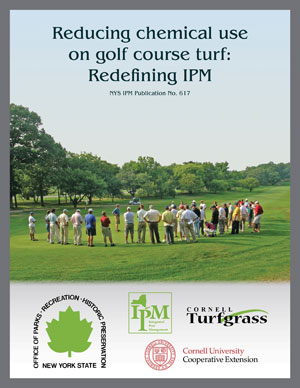
Order now! Reducing Chemical Use on Golf Course Turf: Redefining IPM
Your guide to reducing environmental impact and saving money.
About the manual: There is growing public concern over the use of pesticides and fertilizer on golf courses. At the same time, there is increased demand from the golfing public for immaculate course conditions. This manual will help you resolve that conflict by helping you adopt cultural practices and pest management systems that are less reliant on pesticides and fertilizers. Based on a long-term field research project the Bethpage State Park Green Course, the manual combines new research findings as well as superintendents' experiences to help you develop your own management program to meet the twin goals of healthy turf and environmental sustainability.
Credits: The Bethpage study was initially funded by the United States Golf Association (USGA), subsequently by the Northeastern IPM Center (USDA-CSREES), and currently by the NYS Office of Parks, Recreation and Historic Preservation (OPRHP). OPRHP and Bethpage State Park in particular have been extremely supportive of this project, and have contributed immeasurable in-kind services. In addition to these organizations, the Golf Course Superintendents Association of America (GCSAA) and their Environmental Institute for Golf (EIFG) dedicate resources to funding scientific research and providing education on best management practices for golf. Amongst all these groups promoting environmental stewardship, New York State's commitment to reducing pesticide use on 29 state operated golf courses may represent the largest environmental leadership initiative in the industry, and paves the way for improving the environmental compatibility of golf. |

Department of Horticulture, 134A Plant Sciences Bldg, Ithaca, NY 14853 USA, email: hort@cornell.edu | 607-255-4568/1789 | Fax, 607-255-9998/0599
© 2007 Department of Horticulture, College of Agriculture and Life Sciences, Cornell University